
The Disability Policy Centre
Accessible transport begins long before someone boards a bus or train. For many disabled people, barriers on streets and pavements can make it difficult, unsafe or impossible to reach transport services in the first place.
Through the Scaling Innovation Programme, The Disability Policy Centre developed the Street Transformation Execution Plan (STEP), a practical blueprint designed to help local authorities identify and address barriers within the street environment. The project focused on some of the most common issues reported by disabled people, including pavement parking, street clutter, bins left on pavements, and roadworks that disrupt journeys.
The Challenge
While many local authorities recognise the importance of accessibility, councils often face competing priorities, limited resources and a lack of practical guidance on how to improve street access in a consistent and meaningful way.
Street accessibility is about more than individual obstacles. It is about whether people can travel safely, independently and confidently through their local environment. Barriers such as obstructed pavements, inaccessible crossings or poorly managed roadworks can limit access to employment, education, public services and social opportunities.
The Disability Policy Centre recognised the need for a practical framework that could help councils move from awareness to action. The aim was not simply to identify barriers, but to develop a set of recommendations that local authorities could adopt and adapt within their own communities.
Developing the STEP Framework
The project resulted in the creation of STEP, a Street Transformation Execution Plan that provides local authorities with a clear and replicable approach to improving street accessibility.
Drawing on research, stakeholder engagement and lived experience, the framework sets out 12 recommendations covering policy, planning, enforcement, behaviour change and community engagement. These recommendations include embedding accessibility into local decision-making processes, strengthening local accountability, improving approaches to pavement parking, and developing locally led campaigns to encourage more accessible behaviours.
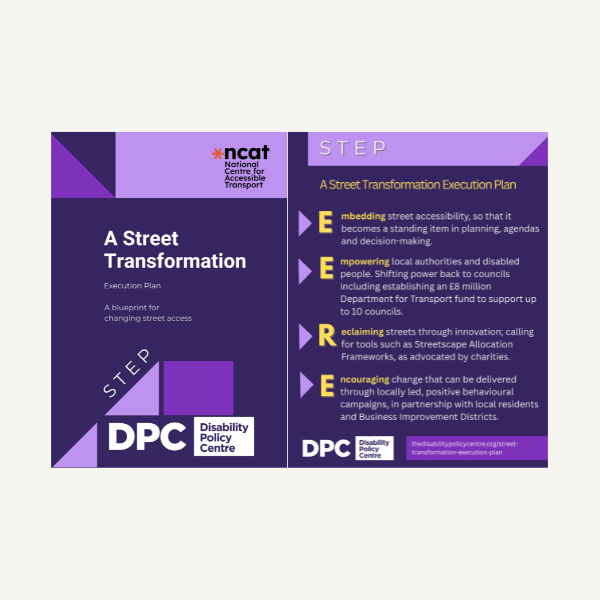
Alongside the report, the project developed social media campaign assets designed to support awareness raising and behaviour change at a local level. The recommendations were subsequently shared with policymakers and stakeholders through a parliamentary launch event, helping to raise the profile of street accessibility as a transport issue.
Working with Disabled People
Co-production was central to the project.
The Disability Policy Centre’s team includes people with lived experience of disability, and the project also worked closely with disabled people in Coventry through the Disability Equality Action Partnership (DEAP), a long-established local co-production group. Through online and in-person workshops, participants shared their experiences of navigating local streets, identified barriers within the built environment and tested emerging policy recommendations.
The feedback shaped key elements of the final report, including recommendations relating to enforcement, reporting mechanisms, pavement parking and local accountability. Participants also helped co-design awareness-raising campaign materials, ensuring the outputs reflected local experiences and priorities.
This collaborative approach ensured the recommendations were grounded in lived experience and focused on practical solutions that could be implemented by local authorities.
Impact
The project demonstrates how policy innovation can help remove barriers within the transport system.
Rather than focusing on individual behaviour or an impairment, STEP highlights the role that street design, policy decisions and local governance play in shaping accessibility. By providing councils with practical tools and evidence-based recommendations, the project has the potential to support more accessible streets, safer journeys and greater independence for disabled people.
The framework is already being shared with policymakers, local government stakeholders and transport organisations, creating opportunities for wider adoption. It has also strengthened partnerships between disabled people, local authorities and transport stakeholders, helping build momentum for future action.
What Happens Next?
The Disability Policy Centre is now focused on supporting local authorities to implement the STEP framework and explore the development of locally co-produced Street Charters.
Future work will focus on helping councils translate recommendations into action, expanding engagement with transport providers and policymakers, and building further evidence to support long-term change.
By providing a practical blueprint for action, STEP demonstrates how collaboration, evidence and lived experience can help create streets that work better for disabled people and support more accessible journeys for everyone.
The Street Transformation Execution Plan
The STEP Plan is available as a download via the Disability Policy Centre’s website linked here
https://thedisabilitypolicycentre.org/street-transformation-execution-plan