
REACT Accessibility
REACT Accessibility develops technology that helps disabled people access information and services more independently. Through the Scaling Innovation Programme, the organisation developed and tested a new approach to accessible communication at bus stops, enabling passengers to request a bus to stop, receive confirmation that the request has been received and identify the correct bus when it arrives.
The project focused on one of the most overlooked parts of the bus journey: the interaction between the passenger, the bus stop and the driver.
The Challenge
Accessible bus travel depends on more than accessible vehicles and infrastructure. For many disabled people, particularly blind and visually impaired passengers, knowing which bus has arrived, signalling to a driver that they wish to board and identifying the correct service can be significant barriers to travel.
While real-time information is increasingly available, much of it is not accessible or actionable. Passengers may still need to locate the correct bus stop, identify the right bus among multiple services and ensure the driver knows they wish to board before the vehicle departs.
These barriers can make travelling by bus stressful, unpredictable and, in some cases, impossible. REACT identified an opportunity to create a solution that would support communication between passengers and drivers while making information more accessible and useful in real everyday situations.
Developing the Solution
The project set out to prove that existing transport data and technologies could be used to create a more accessible and connected experience at the bus stop.
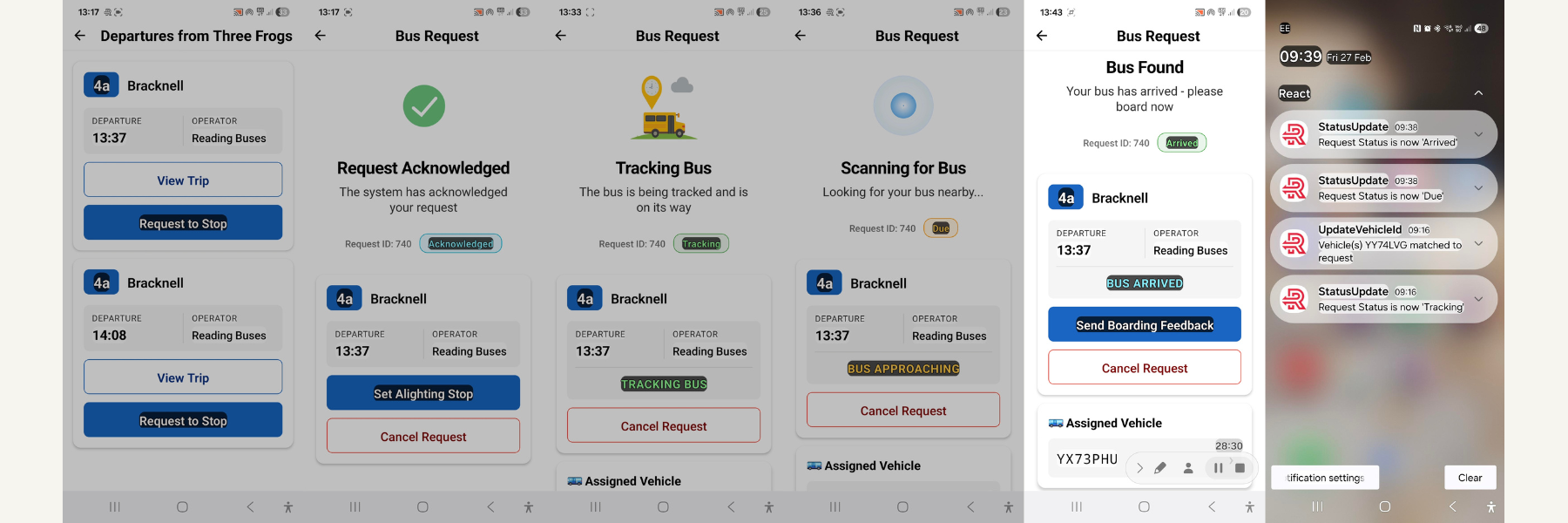
Using open data from the Department for Transport’s Bus Open Data Service (BODS), REACT developed a demonstrator, called the REACT Access Trigger, that allows passengers to access real-time bus information, request a specific bus to stop and receive confirmation when their bus arrives. The solution also allows passengers to request a stop when approaching their destination, helping to support safe and confident alighting.
The demonstrator was integrated with REACT’s existing accessible communication technology, which provides audio and visual notifications through smartphones, smartwatches, talking displays and beacons. Together, these technologies create a more accessible and actionable information system that supports passengers throughout the journey.
A key achievement of the project was moving the concept from an early-stage idea to a working demonstrator that uses live transport data and can be integrated with existing bus industry systems.
Below is a series of screenshots showing the REACT Ap in action from identifying an oncoming bus, to safely boarding.
Working with Disabled People
Disabled people were involved throughout the project, helping to shape both the concept and the final demonstrator.
REACT worked extensively with blind and visually impaired people through the Thomas Pocklington Trust and regional Sight Loss Council networks. Workshops, user testing sessions and one-to-one discussions explored the barriers people face when using buses and gathered feedback on how the solution should operate.
Participants consistently highlighted the importance of keeping the process simple, reliable and automated. Their feedback directly influenced the design of the demonstrator, including features such as bus identification, alighting requests, service information and audio-visual notifications. Testing also led to improvements in smartwatch functionality and user experience.
Importantly, the project was guided by the principle that accessibility should not depend on passengers having to overcome barriers themselves. Instead, the solution aims to remove barriers by improving communication and ensuring transport systems respond more effectively to passenger needs.
Impact
The project demonstrated that accessible, actionable communication between passengers and bus services is both technically feasible and strongly supported by users.
The solution has the potential to improve confidence, independence and safety for disabled passengers by reducing uncertainty at bus stops and supporting more reliable boarding and alighting. While initially developed with blind and visually impaired passengers, stakeholders identified potential benefits for a much wider range of passengers, including wheelchair users and people with other access requirements.
The project has also attracted significant interest from transport authorities, operators, industry bodies and technology providers. Organisations including Transport for Greater Manchester, Essex County Council, South Yorkshire Mayoral Combined Authority, Campaign for Better Transport, Traveline, the Confederation of Passenger Transport, Wokingham Council, Reading Buses, TransMach and Ticketer have all expressed interest in supporting future trials and development.
What Happens Next?
With a working demonstrator now in place, REACT is focused on progressing live trials with transport authorities, operators and technology partners.
Future development will include refining the user experience, integrating the solution with existing bus systems and expanding testing with a wider range of disabled passengers. The organisation is also exploring opportunities to integrate the technology into journey planning tools, bus stop infrastructure and wider passenger information systems.
By transforming information into action, the project demonstrates how technology, co-production and accessible design can help create a bus network that is easier to use, more responsive and more inclusive for everyone.
The REACT Access Trigger and how to access it
More information about how to use the REACT Access Trigger can be found on ReACT Accessibility’s own website linked below
https://react-access.com/react-ncat-project/
The REACT Access Trigger App demonstrater version can be downloaded from the App store via the link below
https://apps.apple.com/gb/app/react-access-trigger/id1591749718