
ncat’s core value is that our work starts and ends with disabled people, and we amplify the voices of disabled people in all decision-making
In June 2023 we set up the Community of Accessible Transport (CAT) panel and began our call our for disabled people to sign up to be part of our work.
The panel enables members to:
• Get involved in shaping the future of transport for disabled people.
• Share ideas. Learn from others. Find solutions that work.
• Receive incentives for taking part in the research.
Membership is predominately for disabled people but we also welcome parent(s) or carers of disabled children or adults, transport sector workers who want to make transport accessible for disabled people, members of disability charities, and researchers within higher education institutions interested in the work of ncat.
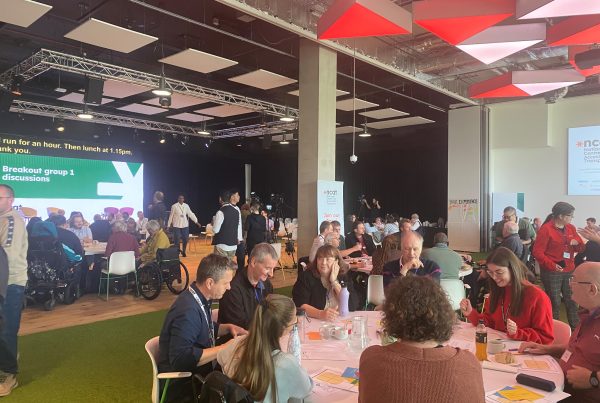
Since we launched over 3,400 people have joined the panel, giving key insights and valuable evidence that ncat and can use to influence policy and drive change. Over 30 panel members were funded to join us in person at the recent Accessible Transport Summit in September 2024, (as shown in the image here), to engage directly with transport professionals and policy-makers and directly influence ncat’s research priorities and grant funding programme.
How CAT Panel members engage with research
CAT Panel members bring their lived experience and perspectives into research in a range of ways. Members can choose to take part in different types of activity depending on the research and the level of involvement required.
This can include:
- Responding to surveys to share views and experiences on topics such as policy, innovation, products and services. This enables ncat to hear from a large and diverse group of panel members.
- Helping to design research through Expert by Experience groups. Members can help shape research questions and approaches, and test assumptions and draft findings, making sure that research reflects the real experiences and priorities of disabled people.
- Taking part in research activities such as focus groups, workshops and accompanied journeys. These provide opportunities to explore people’s experiences and views in greater depth.
- Advising and challenging research projects by joining project advisory groups or boards. Members may be involved throughout a project, providing ongoing lived-experience insight, scrutiny and challenge.
- Working as peer researchers, where members take a more active role in carrying out research themselves, for example during fieldwork.
- Assessing new ideas and innovations, including through the Scaling Innovation programme. Members use their lived experience and consumer perspective to help assess whether proposed innovations respond to genuine needs and are likely to make a meaningful difference to disabled people’s lives.
In short
CAT Panel involvement can be much broader than completing surveys. Members can contribute at different stages of the research process, from sharing experiences, to shaping and carrying out research, advising projects, and helping assess new ideas and innovations.
This means members can engage at different levels, depending on their interests, experience, availability and the opportunities available.
To read first hand accounts of panels members about what they’ve been involved with, and what they’ve got from the experience you can read some recent blogs posts linked below
https://www.ncat.uk/2024/10/17/airports-are-too-bright-too-loud-and-its-never-clear-where-to-go-meet-cat-panel-member-sarah/
To read more or to join the panel please visit the sign-up page.
Find Support
We understand that by taking part in research with ncat, you may be sharing experiences that may have been distressing to you. While ncat doesn’t provide support to individuals, we would advise you to contact the organisations on this link to access organisations and services who do.