
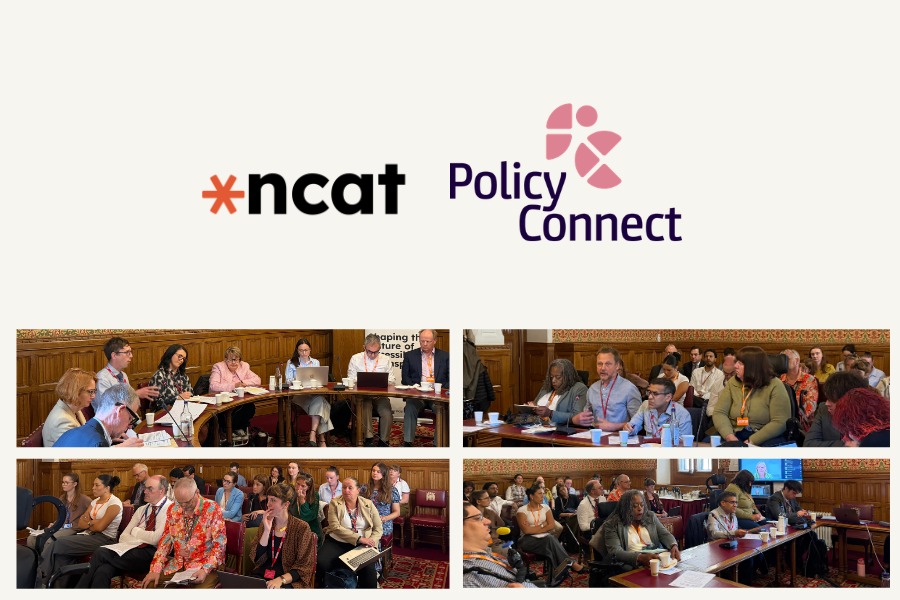
The National Centre for Accessible Transport (ncat) and consortium partner Policy Connect brought together parliamentarians, policymakers, regulators, transport professionals, researchers and disabled people’s organisations at the House of Lords on 16 June for an Accessible Transport Policy Commission (ATPC) roundtable exploring disabled people’s legal right to transport.
The ATPC is a key part of ncat’s convening role and is delivered in partnership with Policy Connect, which provides the Commission’s secretariat. Through parliamentary roundtables, evidence sessions and cross-sector discussions, the Commission supports collaboration between policymakers, disabled people and transport stakeholders to identify barriers and inform practical action to improve transport accessibility.
Chaired by Baroness Tanni Grey-Thompson, this roundtable examined the gap that continues to exist between disabled people’s rights in law and their experiences of transport in practice.
The discussion formed part of the Accessible Transport Policy Commission’s ongoing programme of work to identify opportunities to improve transport accessibility through evidence, policy development and cross-sector collaboration.
The event took place at a significant moment for transport accessibility policy. Participants reflected on the Transport Select Committee’s Access Denied report, the Law Commission’s review of transport accessibility legislation in England and Wales, and the Equality and Human Rights Commission’s Guiding Principles for Accessible Transport. Together, these developments present an opportunity to strengthen the legal and policy frameworks that underpin accessible transport across the UK.
New research explores complaints in accessible transport
The first part of the session focused on emerging findings from ncat research exploring disabled people’s experiences of making complaints when things go wrong on public transport.
Presented by ncat researcher Dr Paola De Pascali from Coventry University, the research examined the barriers disabled people experience when making complaints, and the role complaints processes can play in improving accessibility across the transport network.
Drawing on a survey of 500 disabled people and a programme of qualitative interviews, the research found that fewer than half of disabled passengers who experienced a negative transport journey went on to make a formal complaint. Many participants reported that they believed nothing would change, did not expect their concerns to be acted upon, or felt the process required too much time and effort following an already difficult experience.
The findings suggest that complaints are about more than customer feedback. They provide an important source of evidence about whether accessibility is working in practice and can help identify barriers, support accountability and inform service improvement across the transport system.
Participants also discussed a proposed “Three Makes” framework emerging from the research, focused on making complaints systems simple, easy and worthwhile for disabled passengers. The framework aims to support transport organisations in developing complaints processes that are accessible, transparent and capable of demonstrating meaningful action.
The research will launch in summer 2026 and provide valuable evidence on how complaints processes can support accountability and drive improvements in accessible transport.
Examining the gap between rights and reality
The second part of the roundtable explored disabled people’s legal right to transport and the factors that continue to contribute to the gap between rights in law and experiences in practice.
The panel featured Ruth Cadbury MP, Chair of the Transport Select Committee; Connor Johnston, Senior Lawyer at the Law Commission of England and Wales; Dr Mary-Ann Stephenson, Chair of the Equality and Human Rights Commission (EHRC), Mark Wright, EHRC Senior Associate; Michael Lorimer, Head of the Secretariat of the Inclusive Mobility and Transport Advisory Committee (IMTAC) and ncat CEO Dr Emma Partlow.
Drawing on evidence from the Transport Select Committee’s Access Denied report, Ruth reflected on the continuing challenges disabled people face when travelling and the need to ensure accessibility is considered consistently across the transport system.
Connor Johnston outlined the scope of the Law Commission’s review of transport accessibility legislation, which will examine how existing laws can be simplified, modernised and made more effective. He highlighted the importance of robust evidence and lived experience in understanding how accessibility legislation operates in practice, ensuring disabled people’s experiences are reflected throughout the review process. Connor also acknowledged concerns about the burden often placed on individuals to challenge inaccessible services and the need to consider whether existing legal frameworks and enforcement mechanisms are delivering the outcomes they were intended to achieve.
Dr Mary-Ann Stephenson discussed the Equality and Human Rights Commission’s Guiding Principles for Accessible Transport and highlighted transport’s role in enabling access to employment, education, healthcare, family life and wider participation in society. Mary-Ann emphasised the importance of embedding equality and human rights throughout transport planning, policy and service delivery.
Michael Lorimer provided a perspective from Northern Ireland, highlighting the importance of consistency, collaboration and meaningful engagement with disabled people when designing and delivering transport services.
Key themes from the discussion
Throughout the morning, several common themes emerged as participants discussed the fragmented nature of transport accessibility responsibilities, with different approaches, standards and complaints processes operating across transport modes and organisations.
There was also conversation around enforcement, accountability and the need to ensure accessibility is considered throughout the entire passenger journey rather than at individual touchpoints.
Contributors highlighted the importance of accessible complaints systems, clear information, consistent standards and meaningful involvement of disabled people in shaping transport policy, legislation and services.
The discussion reinforced the value of bringing together evidence, lived experience and policy expertise to inform future legislation, regulation and investment decisions.
Turning evidence into action
Closing the session, Dr Emma Partlow, Chief Executive Officer of ncat, reflected on the importance of ensuring that research and evidence lead to practical improvements across the transport system.
Emma highlighted ncat’s role in developing and sharing evidence that supports policymakers, transport operators and industry partners to better understand barriers and identify opportunities for change. She also emphasised the importance of continued collaboration across sectors to ensure disabled people’s experiences remain at the centre of future transport policy and decision-making.
The roundtable demonstrated the value of the Accessible Transport Policy Commission as a forum for bringing together Parliament, government, regulators, transport organisations, disabled people’s organisations and researchers to discuss practical solutions and opportunities for collaboration.
Through the partnership between ncat and Policy Connect, the Commission will continue to support evidence-informed discussions that help shape policy, improve practice and remove barriers to transport for disabled people across the UK.