
On Monday 23 March 2026, the National Centre for Accessible Transport (ncat) brought together innovators, accessibility experts, and funders at Coventry University’s National Transport Design Centre – for a unique event focused on a shared challenge: how to make accessibility an integral foundation of transport innovation, not an afterthought.
Supported by Innovate UK Business Connects’ Accessible and Inclusive Transport Programme, alongside consortium partners including the Research Institute for Disabled Consumers (RiDC) and Connected Places Catapult, the visit highlighted the important role accessibility plays in driving both social change and economic growth.
A clear message emerged from the outset; innovation is stronger when accessibility is embedded early and shaped by lived experience.
Emma Partlow, Chief Executive Officer of ncat, said:
“Accessibility should be considered from the very start of the innovation process, not treated as a final step. When we design with disabled people and build on robust evidence, we create solutions that are more effective, more inclusive, and better positioned to scale. This is key to making travel accessible for everyone and locking many other opportunities for the transport sector.”
Speakers from across ncat’s consortium reinforced the importance of embedding accessibility through lived experience. Rebecca Posner and Fay Yorath from RiDC (Research Institute for Disabled Consumers) highlighted that when disabled people are involved in the process, solutions become more relevant and impactful. Jamie Chan-Pensley from Connected Places Catapult added that this approach also leads to more usable and scalable transport innovations.
Throughout the morning, guest innovators demonstrated inclusive design in practice. Examples included accessible, high-quality immersive virtual tours developed by Virtual Tour Experts, and Brunel University London’s hands-free wheelchair, designed to improve safety and usability in real environments. These examples illustrate a shift from concept to practical, user-informed solutions.
A consistent set of principles emerged across sessions. Accessibility should be embedded at every stage, driven by clear communication, meaningful engagement, and genuine co-design with disabled people to create strong, inclusive processes and better outcomes.
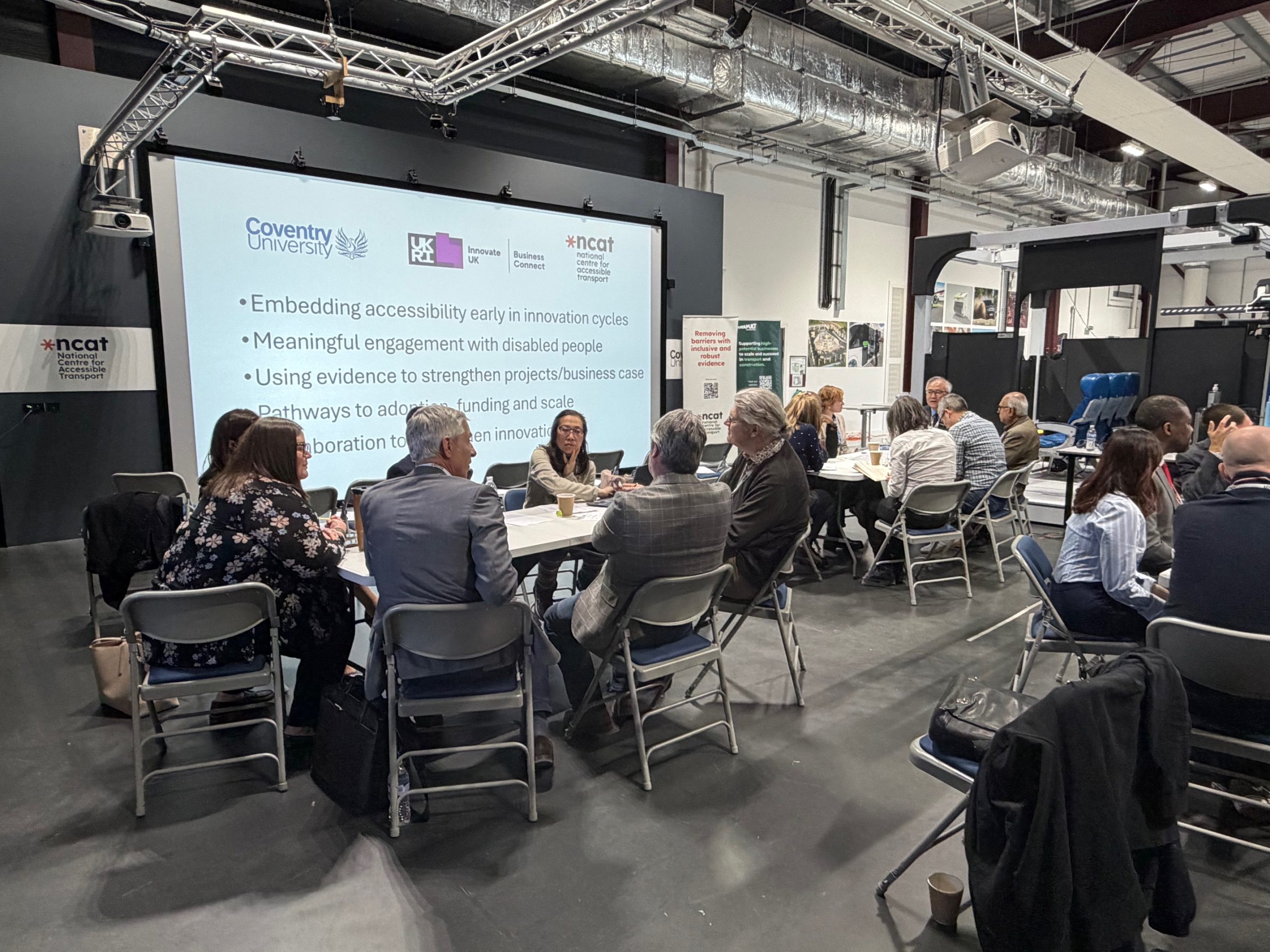
In the afternoon, roundtable discussions focused on how to translate these principles into delivery. Conversations centred on strengthening connections between research and innovation, improving access to funding, and expanding opportunities for prototyping and testing.
Participants highlighted the importance of building strong evidence through real insights, supporting pathways to adoption and scale, and enabling collaboration across organisations. There was also a shared ambition to improve visibility of funding opportunities, align approaches to standards and regulation, and create more opportunities to bring ideas to life.
The event reinforced a central message; accessibility, embedded through co-production, is fundamental to delivering innovation that is relevant, scalable, and impactful.
Image Description
Several small groups of people are seated around tables in a contemporary, industrial-style venue, engaged in roundtable discussions. A large presentation screen at the front displays key themes including embedding accessibility early, meaningful engagement with disabled people, and using evidence to strengthen projects and business cases. Logos for Coventry University, Innovate UK Business Connect, and the National Centre for Accessible Transport (ncat) are visible on the screen. Participants are actively talking and listening, suggesting collaborative discussion. The space features exposed ducting, overhead lighting rigs, and demonstration equipment, reinforcing an innovation-focused environment.