
Three years ago, the National Centre for Accessible Transport (ncat) was established with a clear purpose: to strengthen the evidence base needed to help transport systems work better for disabled people across the UK.
Disabled people continue to make significantly fewer journeys than non-disabled people, a gap that has remained largely unchanged for more than a decade. This inequality affects access to employment, education, healthcare, social connection and everyday participation. Until recently, there was no dedicated national centre focused on developing independent, high-quality evidence to address these challenges at a system level.
Funded through a £20 million, seven-year grant from the Motability Foundation, ncat was created in 2023 as a national evidence centre for accessible transport. Guided by the social model of disability, the centre focuses on understanding how barriers arise from systems, environments and decision-making, rather than from individuals themselves.
Disabled people’s experiences sit at the heart of ncat’s work. Through the Community of Accessible Transport (CAT) Panel, now comprising more than 3,700 members, participants contribute directly to research and engagement activity, helping ensure insight reflects real journeys and everyday realities. Alongside collaboration with Disabled People’s Organisations, community groups and stakeholders through initiatives such as the Accessible Transport Policy Commission, ncat connects lived experience with policy development, innovation and industry practice.
Over its first three years, ncat has produced 17 major research outputs, and over 178 tailored recommendations, examining accessibility across entire journeys, from streets and pavements to vehicles, stations, information systems and governance. More than 8,600 participants have taken part in research and engagement activity, including providing clear evidence, based guidance across policy, design, funding, and operational decision-making. This reach reflects ncat’s growing role as a trusted connector, bridging lived experience, evidence, innovation, and decision-making.
Innovation has been central to turning evidence into usable and practical tools such as our publicly available interactive Transport Barriers Database, a growing Resource Collection of over 650 papers and projects, eight Design Opportunities, and an Accessibility Dataset Toolkit.
ncat’s consortium brings together six partner organisations, grounding the evidence centre in a multi-faceted approach to making transport more accessible. As consortium lead, Coventry University provides academic leadership and delivers applied research designed to inform policy and practice. Connected Places Catapult delivers ncat’s Scaling Innovation funding programme, supporting innovators to develop solutions that address accessibility challenges. Designability contributes human-centred design expertise, translating user insight into practical guidance for industry, RiDC works closely with our CAT panel, while WSP helps embed findings within infrastructure planning, engineering and service delivery contexts. To help ensure our findings and recommendations move policy and practice forward, Policy Connect bring our researchers together with parliamentarians and policy makers in our Policy Commission events.
Together, these partnerships are helping establish a joined-up UK-wide evidence base that supports more consistent and accountable approaches to accessibility across policy, design and delivery.
In November 2025, ncat appointed Emma Partlow as our new CEO with a goal that the future of the centre “strengthens the integration of robust evidence, lived experience, and cross-sector collaboration to support more consistent, accountable, and evidence-informed approaches to policy and delivery.” Partlow acknowledges pride in what has been achieved, but states that “there is more to do. We will deepen our partnerships across the UK to turn insight into practical tools, guidance, and innovative solutions that can remove barriers in transport.”
As ncat enters its next phase, the focus remains on commissioning robust research that provides evidence and tools for stakeholders to adopt, which can support long-term change, to improve journeys for disabled people across the UK.
Explore our work and resources: https://www.ncat.uk/
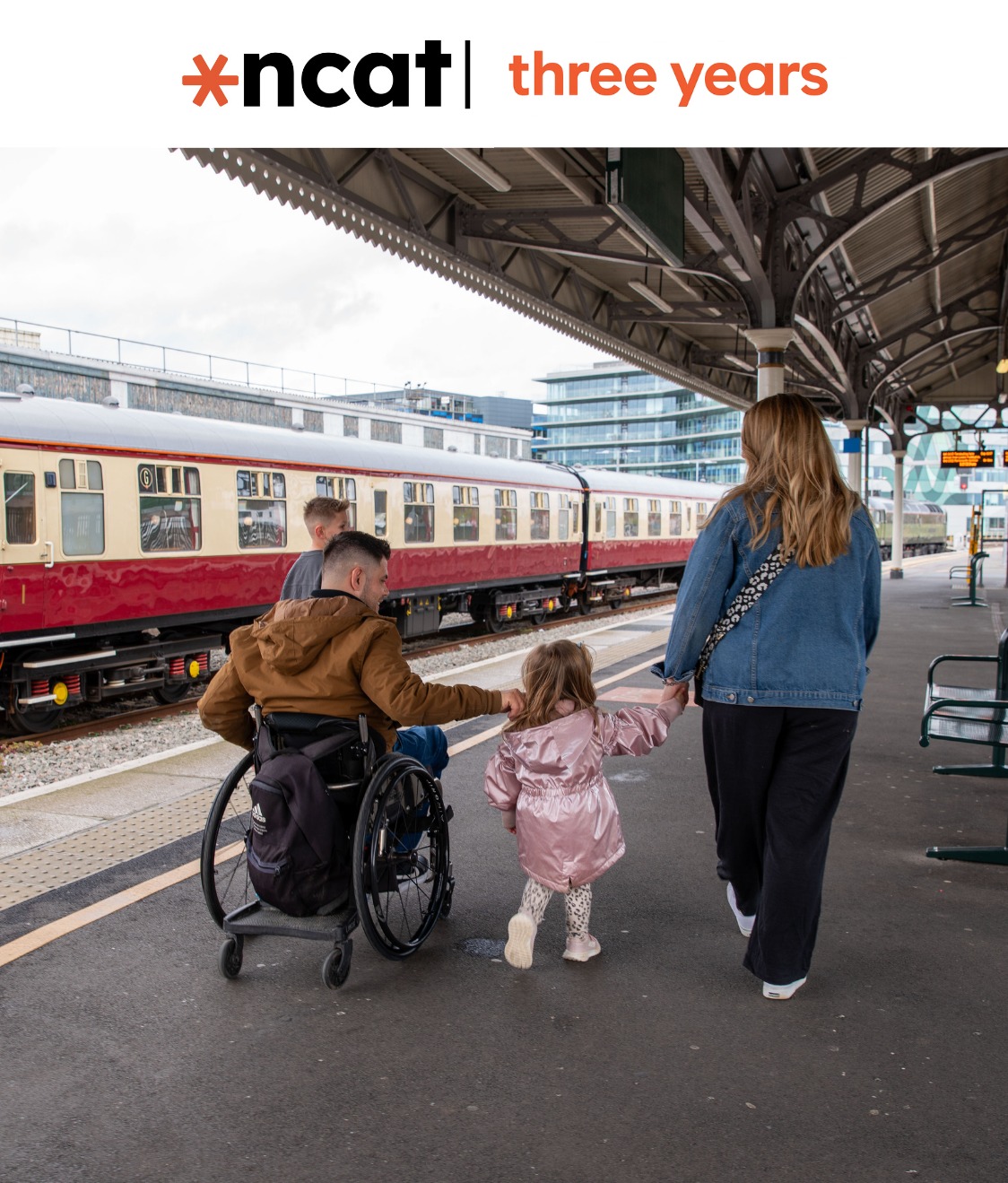
Image description:
A family walks along a railway station platform. An adult wheelchair user moves alongside a woman and a young child holding hands, with a train stopped beside them. The ncat “three years” branding appears on the image.